So picture this. A few hundred monkeys and bears, standing at the very southern tip of India, staring out at an ocean that just… does not end. No boats. No bridge. Nothing but water all the way to the horizon. And somewhere on the other side of it, a kidnapped queen is running out of time.
This is the story of how one of them found a way across. If you know the Ramayana at all, you probably know the ending, Hanuman finds Sita, Lanka eventually burns, Ravana eventually loses. But the getting there is the good part. It’s called Sundara Kanda in Valmiki’s original Sanskrit text, literally “the beautiful chapter,” and it’s the only book in the entire Ramayana where the hero isn’t Rama. It’s Hanuman’s book. Some scholars think it’s named after Hanuman himself, whose mother Anjana used to call him “Sundara” as a boy. Either way, it’s the part people quote, the part people recite when they need courage, and honestly, the part that has the most fun packed into it.
Stuck at the Edge of the World
Let’s back up for one second. Sita has been taken by Ravana, the demon king of Lanka. Rama has allied with Sugriva, the exiled monkey king, and in exchange for help getting his throne back, Sugriva sends out search parties in all four directions to find her. The group headed south, led by a young prince named Angada with the wise old bear Jambavan and Hanuman among them, is the one that matters, because south is where Lanka actually is.
They search every cave, every forest, every mountain pass in the south of India. Nothing. And then a bird named Sampaati, brother of the great vulture Jatayu who died trying to save Sita, tells them something useful: she’s alive, she’s on an island called Lanka, and it’s across the sea.
Which is when everyone’s stomach drops. Because the ocean in front of them is, by every account, enormous. The old texts describe it as a hundred yojanas wide, an ancient unit of distance that scholars still argue over, but the point isn’t the exact number. The point is that it looked, to every single monkey standing there, completely and totally impossible.
And here’s the part I love. This wasn’t just a logistics problem. Sugriva had given them a deadline. They’d been gone a long time already. Angada, still young and already anxious about his standing, starts talking about how they might as well sit down and starve themselves rather than go back and face Sugriva’s anger empty-handed. It’s a genuinely dark moment. A whole search party, ready to give up, sitting on a beach, out of ideas.
The Monkey Who Forgot He Was a God
This is when Jambavan turns to Hanuman and says, more or less, “Why are you just standing there?”
Because here’s the thing about Hanuman that a lot of people don’t know unless they’ve gone deep into the story: he wasn’t acting modest. He had actually forgotten how powerful he was.
As a baby, the story goes, Hanuman saw the rising sun and, thinking it was a piece of ripe fruit, leapt up to grab it. He very nearly succeeded, he was the son of Vayu, the wind god, after all, so distance was never really his problem. Indra, alarmed, struck him out of the sky with his thunderbolt, the vajra, and the blow injured his jaw. That’s actually where his name comes from: “hanu” means jaw. Vayu was so furious at his son being hurt that he temporarily withdrew air from the entire universe, which is the kind of thing that gets every god’s attention very quickly. To calm things down, the gods showered Hanuman with boons instead, near-invincibility, the ability to change size at will, the power to fly.
But Hanuman grew up mischievous, using those powers to prank meditating sages in the forest, and eventually a group of them, exhausted by his antics, cursed him to forget his own strength until someone reminded him of it. He’d carry all that power around his whole life without knowing it was there.
Which is exactly what’s happening on this beach. Jambavan, who’s ancient enough to remember Hanuman’s childhood, lays out the whole story in front of everyone. Reminds him who his father is. Reminds him what he’s capable of. And something in Hanuman just… shifts. He starts to grow. Not metaphorically, actually physically, expanding until he’s the size of a mountain, standing on Mount Mahendra, ready to jump.
The Leap Across the Ocean
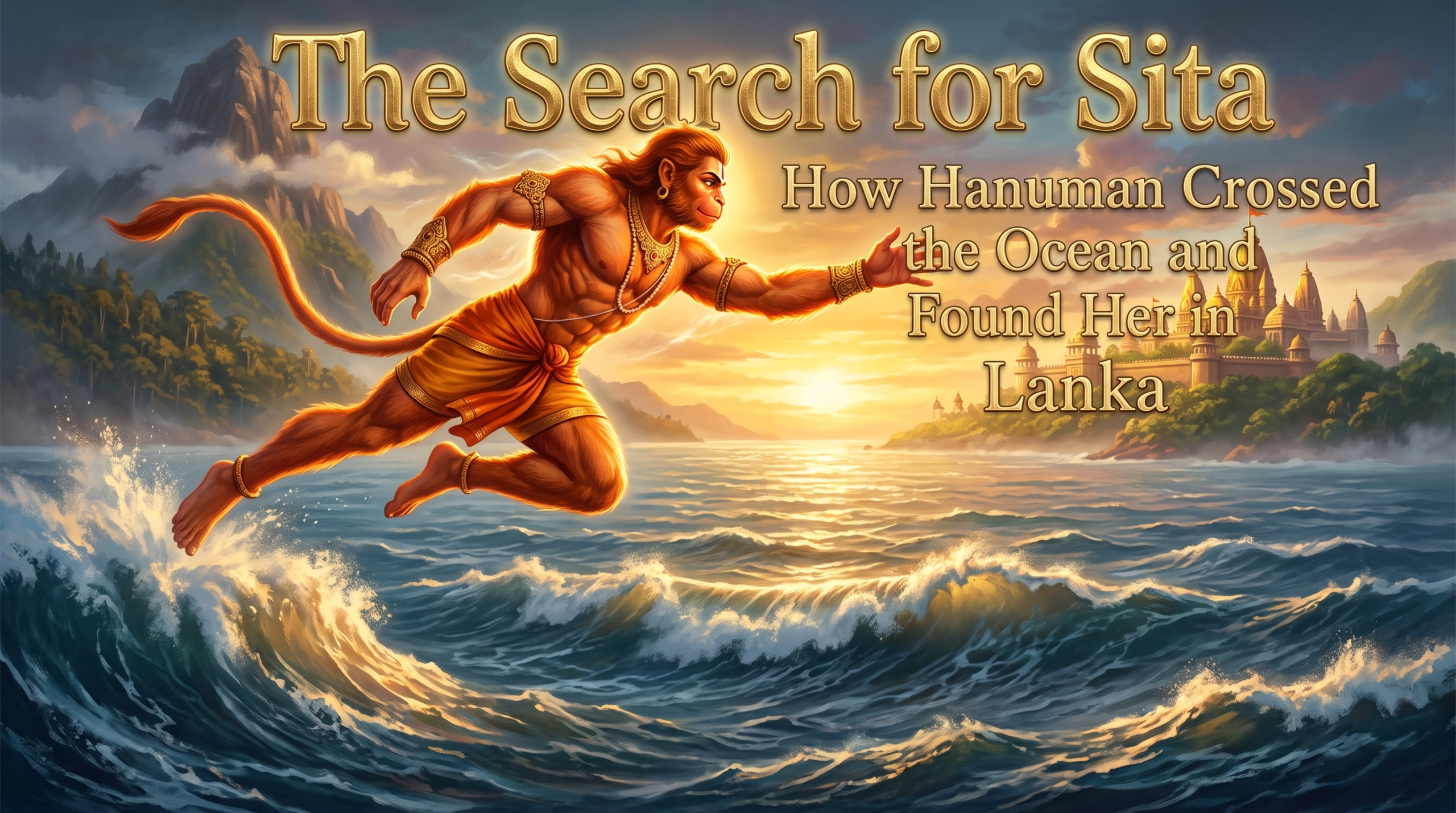
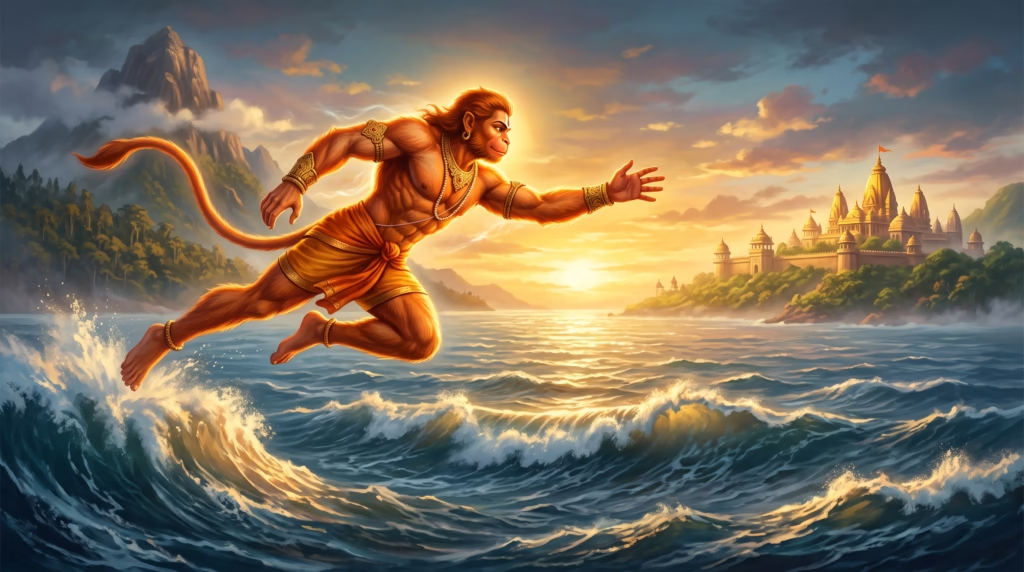
This is the moment illustrators love, and for good reason. Hanuman crouches down, the whole mountain reportedly shaking under his weight, and launches himself into the sky toward Lanka.
Three things try to stop him on the way, and each one tells you something different about who he is.
The first is Mount Mainaka, which rises up out of the ocean and offers him a place to rest. Turns out Mainaka owes a debt to Hanuman’s father Vayu. Long ago, mountains had wings and flew wherever they liked, until Indra, worried they’d land somewhere and cause chaos, started clipping their wings with his thunderbolt. Vayu hid Mainaka under the sea to save it. So now, out of gratitude, the mountain offers Hanuman a break. Hanuman, mid-flight, politely declines, he touches it briefly out of respect, but he doesn’t have time to stop. There’s a nice bit of restraint in that. He’s not showing off. He’s on a mission.
The second is Surasa, mother of serpents, sent by the gods to test him. She opens her mouth, enormous, and tells him he has to enter it before he can pass. Hanuman starts growing to match her size. She grows bigger too. This could go on forever, so instead he shrinks down to the size of a thumb, darts in and out of her mouth in an instant, and keeps flying. Wit over brute force. Surasa’s actually pleased, that was the test, and she blesses him on his way.
The third is not a test, it’s an ambush. A demoness named Simhika has the ability to catch a flying creature’s shadow on the water below and drag it down by it. She catches his. Hanuman feels himself being pulled toward the ocean, realizes what’s happening, and does the one thing she doesn’t expect: he lets himself shrink down, flies straight into her mouth, and then expands violently from the inside, killing her instantly and bursting free. No hesitation. She’s dead before she understands what happened.
Three obstacles, three completely different responses: humility, cleverness, and force, deployed exactly when each was needed. It’s honestly a pretty good leadership lesson if you squint at it.
Landing in the Golden City
Hanuman touches down on Lanka and immediately shrinks himself to a small, unremarkable size so he can slip in unnoticed. At the gates, he’s confronted by Lankini, the fierce guardian spirit of the city. He strikes her down, and this is a moment with weight to it, because there was an old prophecy that Lanka’s downfall would begin the day a vanara, a monkey, defeated her at the gate. She recognizes what this means and lets him pass.
Once inside, Hanuman is stunned by what he finds. Lanka isn’t some crude demon fortress, it’s described as staggeringly wealthy, with gold-columned mansions, gardens, and grand courtyards. Ravana might be a monster in how he’s treated Sita, but he was, by every account, an extraordinarily learned and powerful king, a devotee of Shiva and a master of the Vedas himself. That contradiction is part of what makes him such a compelling villain in this epic. He’s not stupid or weak. He’s brilliant, and still fatally arrogant.
Room After Room, and No Sita
Hanuman searches the palace all night. He goes through Ravana’s private chambers, past rows of sleeping wives, and finds no sign of Sita anywhere. There’s a genuinely human moment here where Hanuman catches himself feeling uneasy about having wandered through the women’s private quarters, and then talks himself through it: his intention was pure, he was searching with a clear purpose, not looking at anyone with desire. It’s a small aside, but it’s the kind of interior moral check-in that makes him feel less like an invincible demigod and more like someone actually wrestling with doing the right thing under pressure.
By the time he’s exhausted every room in the palace, he’s genuinely afraid he’s failed. Sita is nowhere. And that’s when he remembers Sampaati’s tip: try the Ashoka Vatika, Ravana’s private garden.
Under the Ashoka Tree
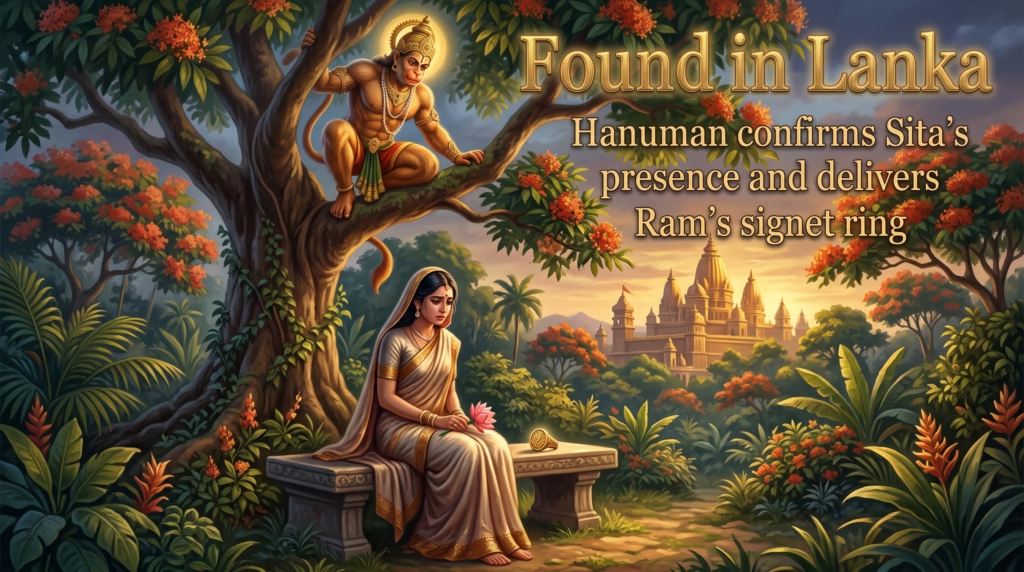
He finds her there. Thin, unwashed, sitting on the bare ground beneath a shimshupa tree, surrounded by rakshasi guards who taunt and threaten her constantly. It’s a rough scene. She’s been refusing Ravana for months, and it shows.
While Hanuman is watching from the branches above, trying to figure out how to approach her without terrifying her, Ravana himself arrives. He tries charm first, then threats, offering her wealth and status if she’ll accept him, promising death if she doesn’t. His wife Mandodari, who genuinely loves him, tries to talk him down. Sita doesn’t waver for a second. She tells him, essentially, that his end is coming and that no threat will change her devotion to Rama. Furious and humiliated, Ravana gives her one more month to decide, then storms off.
Proving He Was Real
Once the rakshasis finally settle down for the night, Hanuman does something clever. Rather than just dropping down in front of a traumatized, terrified woman, he starts quietly narrating the story of Rama from his hiding place in the tree, his lineage, his exile, his love for Sita, speaking just loud enough for her to hear. She looks up, confused, wondering if she’s dreaming or losing her mind.
Then he climbs down, small and unthreatening, and shows her Rama’s signet ring.
Even then, she’s cautious. Ravana had once disguised himself as a wandering ascetic to get close enough to kidnap her in the first place, so she has good reason to be suspicious of appearances. It’s only after Hanuman describes details of Rama’s life that only someone truly close to him could know that she finally lets herself believe it.
Why She Wouldn’t Just Leave
Hanuman offers to carry her back to Rama right then. She says no. Partly it’s principle, she feels it should be Rama who comes to rescue her himself, both for his honor and for hers. Partly it’s more practical: she won’t willingly touch another man’s body, not even to escape.
Instead, she gives him something private to carry back: the story of a crow, once the god Indra’s son in disguise, who pecked at her during her time in the forest with Rama, and how Rama, enraged, retaliated with a weapon so powerful the crow had to flee through all three worlds before finally begging for mercy. It’s a story only she and Rama would know, proof beyond the ring that this really is her. Along with it, she hands over her choodamani, a jeweled hair ornament, to carry back as physical evidence.
Before He Left, He Burned the Place Down
Here’s where Hanuman, having done what he came to do, decides to make sure Ravana understands exactly who just walked through his city. He tears through the Ashoka Vatika, uprooting trees and smashing structures, and kills a string of soldiers and even one of Ravana’s sons sent to stop him. Eventually Ravana’s eldest son, Indrajit, captures him using the Brahmastra, a celestial weapon so sacred that Hanuman allows himself to be bound by it out of respect, even though ordinary ropes could never have held him.
Dragged in front of Ravana, Hanuman delivers Rama’s warning without an ounce of fear, and Ravana, humiliated, orders his tail set on fire as a mocking punishment fit for a monkey. Hanuman lets his tail grow longer and longer as they wrap it in cloth and oil, so it takes forever, and then, once it’s lit, he uses the burning tail to leap from rooftop to rooftop across the city, setting Lanka ablaze. Only the Ashoka Vatika, where Sita still sits, remains untouched.
He douses the flame in the ocean and makes the leap back to the mainland to deliver the news everyone’s been waiting for: he found her, she’s alive, and Lanka knows now that Rama’s forces are coming.
Why This Story Still Matters
What gets me about Sundara Kanda, every time I come back to it, is that the turning point isn’t a weapon or a strategy. It’s a bear telling a monkey who he actually is. Hanuman had the strength to cross that ocean the entire time. He just needed someone to remind him.
That’s probably why this particular chapter gets recited on its own, separate from the rest of the Ramayana, especially on Tuesdays and Saturdays, when people are looking to clear obstacles or find courage they’ve misplaced. It’s tradition, in a lot of households, to even begin a full reading of the Ramayana with this chapter first. Not because it’s the beginning of the story. Because it’s the part that reminds you what’s possible when you stop underestimating yourself.